Elevator Problems - Study Guides
Links to Practice Problems are at the BOTTOM of this Page
My Intro video to elevator problems is HERE
The basis for elevator problems is the same for ALL of our forces problems:
-
If an object experiences unbalanced forces in the "x" or "horizontal" direction, it will accelerate in the direction of the unbalanced force.
-
If an object experiences unbalanced forces in the "y" or " vertical" direction, it will accelerate in the direction of the unbalanced force.
-
If an object is at rest in the "x" or "horizontal" direction the forces in that direction MUST be balanced or absent.
-
If an object is at rest in the "y" or "vertical" direction the forces in that direction MUST be balanced or absent.
Mathematically we express those situations as:
∑Fx = max
∑Fy= may
THEREFORE--
Our job is to
(1) ignore the forces acting in the horizontal ("x") direction. Objects (and people!) inside an elevator are not subject to side-to-side acceleration so we ignore that.
(2) determine if the forces acting in the vertical ("y") direction are balanced or unbalanced.
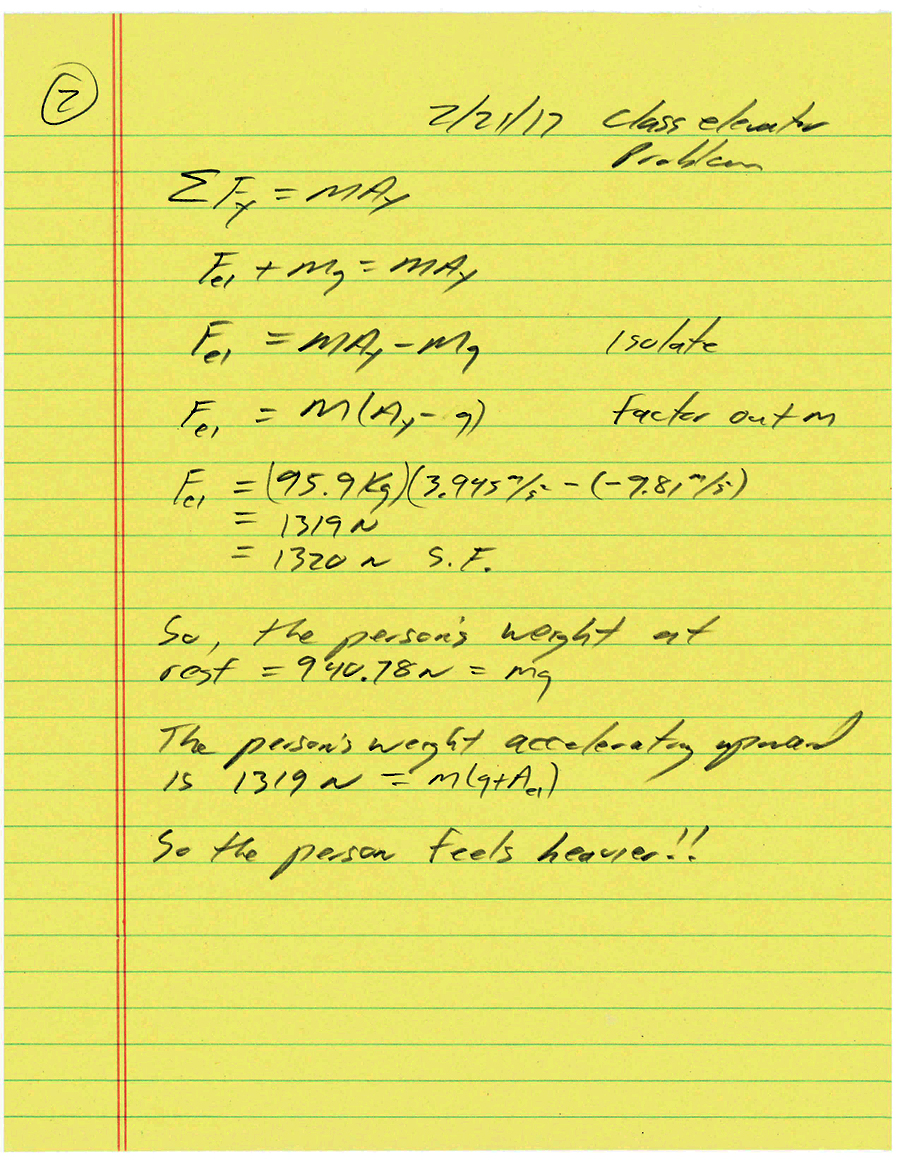
If the object (or person!) inside an elevator accelerates upwards they feel heavier because there is more upward force acting on them than if they were at rest.
If the object (or person!) inside an elevator accelerates downwards, they feel lighter because there is less upward force acting on them than if they were at rest.
TO WIT:
ELEVATOR PROBLEMS REVIEW
Elevator problems can be a wee bit nasty beasts to conceptualize at first, but if we work the steps, they get a WHOLE lot easier a whole lot quicker.
To wit:
Let's consider the case of a person riding in an elevator standing on a bathroom scale to measure their weight.
(We keep in mind that a bathroom scale actually measures how much the springs inside are pushing up on the person standing on the scale)
When the elevator is a rest, the passenger feels the scale pushing up on them with the same force they push down on the scale-- their weight:
w = mg
When the elevator accelerates upwards, the floor of the elevator has to push up on the passenger with a force greater than their weight in order to accelerate them upwards so the scale reads a value larger than the passenger's resting weight.
- When the elevator accelerates downwards, the floor doesn't have to exert as much force to hold the passenger against gravity, so the scale reads a value less than their resting weight.
EXAMPLE:
Now let's step through the opposite situation -- which is to say when the elevator accelerates downwards.
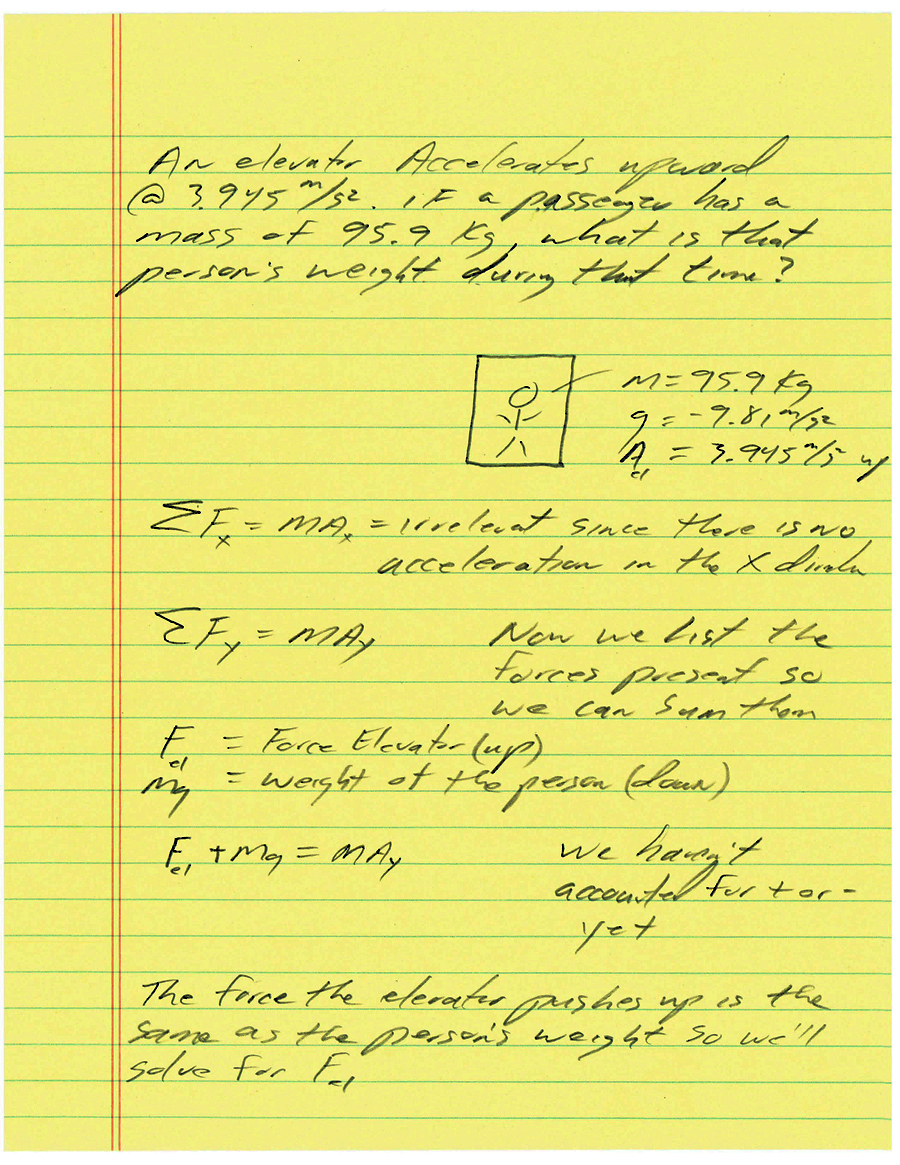
We start by summing the forces as usual:
∑Fx = max(no motion in x)∑Fy= may
Now we list the forces in Y (remember, we'll deal with +/- when we do our substitutions in a moment).
Also, a key to understanding these beasties is to realize that the floor is ALWAYS pushing up on us (Fel), and we imagine we are standing on a bathroom scale showing us just HOW much the floor is pushing up on us:
Fel - weight = ma
Now let's substitute the mathematical equation for the passenger's weight (mg):
Fel + mg = ma
Now let's isolate for the force the elevator floor is pushing up on the passenger:
Fel = ma - mg
Factor out the passenger's mass:
Fel = m(a - g)
Substitute using negative values for the passenger's acceleration (the passenger *is* accelerating downwards after all!) and gravity is ALWAYS negative:
95.5kg(-3.945 m/s/s - (-9.81 m/s/s))
Solve:
= 560 N
Therefore if passenger was standing on a bathroom scale as the elevator accelerated downwards at 3.945 m/s/s the passenger would feel lighter!
Practice #1:
What acceleration must a person (mass = 65.13 kg) experience such that the scale they are standing on reads 999 N?
My video answer is HERE
Practice #2:
What acceleration must a person (mass = 105 kg) experience such that the scale they are standing on reads 734 N?
My solution is HERE
Practice #3:
A person (mass = 49.7 kg) experiences an acceleration of 12.3 m/s/s. Assuming they are standing on a bathroom scale at that time, what would that scale read?
My solution is HERE
Practice #4:
A person (mass currently unknown) experiences an acceleration of .15g That acceleration results in the scale they are standing on reading 825 N. Find that person's mass.
My solution is HERE